

A collective noun is a crucial part of English grammar that facilitates us communicate about businesses in a simple and effective manner. As opposed to naming all people, animals, or components one after the other, a collective noun allows us to refer to the entire group with a single phrase. Because of this, collective nouns are broadly used in spoken English, writing, literature, and academic assessments.
In this article, you will learn what a collective noun is, its guidelines, kinds, and plenty of collective noun examples with sentences to help you recognize the subject without difficulty.
What Is a Collective Noun?
A collective noun is the name of a collection of humans, animals, or things taken as one unit.
Simple Definition:
A collective noun refers to many members; however is treated as one organization.
Example:
- Team (a group of players)
- Flock (a group of birds)
- Class (a group of students)
Why Is a Collective Noun Important?
Gaining knowledge of collective nouns is important due to the fact they:
- Make sentences short and clear
- Improve grammar accuracy
- Assist in assessments and competitive exams
- Enhance spoken and written English
- Are commonly used in stories and articles
The use of collective nouns efficiently makes your English sound more herbal and expert.
Common Examples of Collective Nouns
Here are some broadly used collective noun examples:
- Team
- Class
- Crowd
- Family
- Army
- Committee
- Herd
- Flock
- Pack
- Bunch
- Set
- Group
Every one of these words represents more than one member; however is used as a single noun.
Types of Collective Nouns
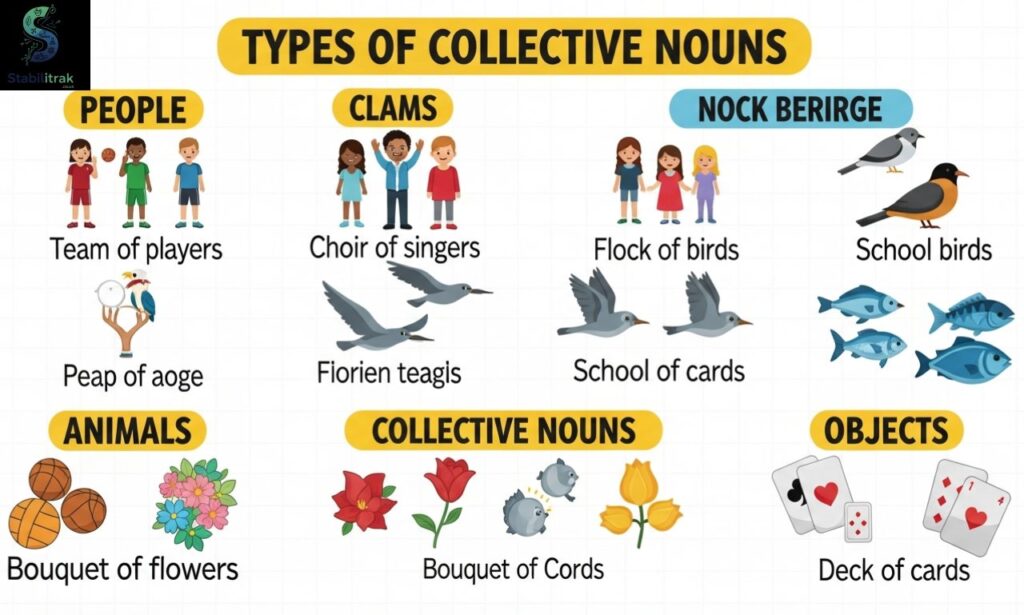
Collective nouns can be divided into three essential sorts primarily based on what they refer to.
1. Collective Nouns for People
Those collective nouns are used for groups of humans.
Examples:
- Team – a group of players
- Class – a group of students
- Crowd – a large group of people
- Family – parents and children
- Committee – a group of decision-makers
- Army – a group of soldiers
Sentences:
- The crew is working towards being tough for the fit.
- The class has been very attentive in recent times.
- A large crowd erupted outside the stadium.
2. Collective Nouns for Animals
Those nouns are used to explain groups of animals.
Examples:
- Herd – cows, elephants
- Flock – birds, sheep
- Pack – dogs, wolves
- Pride – lions
- Swarm – bees, insects
- School – fish
Sentences:
- A herd of cows is grazing within the issue.
- A flock of birds is flying in the sky.
- We saw a faculty of fish inside the river.
3. Collective Nouns for Things
The collective nouns talk over a set of objects or items.
Examples:
- Bunch – keys, flowers
- Bundle – sticks, clothes
- Set – tools, books
- Stack – papers, boxes
- Collection – coins, stamps
Sentences:
- She gave me a gaggle of vegetation.
- A stack of books is lying on the desk.
- He has a group of antique cash.
Rules of Collective Nouns
Knowledge of the policies of collective nouns allows us to avoid grammatical mistakes.
Read More Articles: Material Noun
Rule 1: Collective Nouns Are Usually Singular
A collective noun typically takes a singular verb whilst the organization acts as one unit.
Example:
- The group is prevailing in shape.
- The circle of relatives is planning a ride.
Rule 2: Collective Nouns Can Be Plural (Context-Based)
When the individuals of the organization act for me, a plural verb can be used (especially in British English).
Example:
- The crew is arguing amongst themselves.
- The committee is divided in its critiques.
Rule 3: Pronouns Must Match the Meaning
Pronouns ought to match whether or not the group is appearing as one unit or as people.
Read More Articles: Unique Words to Improve Vocabulary
Example:
- The class finished its test.
- The class shared their ideas.
Collective Noun vs Common Noun
Many learners confuse collective nouns with common nouns.
| Collective Noun | Common Noun |
| Team | Player |
| Flock | Bird |
| Herd | Cow |
| Class | Student |
Explanation:
A collective noun names the group, at the same time as a not unusual noun names a man or woman.
Collective Noun Examples for Students
Here are a few easy and examination-friendly examples:
- The army is properly educated.
- A pack of dogs barked loudly.
- The committee has made a decision.
- A group of grapes is on the plate.
Those examples are typically used in school tests.
Common Mistakes with Collective Nouns
Inexperienced persons frequently make these errors:
❌ the usage of the wrong verb
✔ The team is ready.
❌ Confusing plural meaning
✔ The team is discussing their plans.
❌ the use of pointless plural bureaucracy
✔ A flock of birds (not flocks of birds, unless many groups)
Tips to Master Collective Nouns

- Memorize commonplace collective nouns
- Practice making sentences day by day
- Cognizance of problem-verb agreement
- Read stories and articles carefully
- Solve MCQs and grammar sporting activities
Conclusion
A collective noun performs a vital characteristic in English grammar by allowing us to describe groups of people, animals, or subjects with a single word. Words like crew, beauty, herd, and flock assist in making verbal exchanges clean, concise, and powerful. Through facts about the definition, rules, sorts, and examples of collective nouns, rookies can appreciably improve their grammar and writing skills.
In case you need to speak and write fluent English, gaining knowledge of collective nouns is a necessity.
FAQ’S
1. What is a collective noun?
A collective noun names a group of people, animals, or things as one unit.
2. Give an example of a collective noun.
A team of players is an example of a collective noun.
3. Are collective nouns singular or plural?
They are usually singular but can be plural depending on the sentence.
4. Can collective nouns be used for animals?
Yes, for example, a herd of cows or a flock of birds.
5. How do collective nouns help in sentences?
They make sentences shorter and clearer by referring to a group as one.
6. Is “family” a collective noun?
Yes, family is a collective noun.
7. Do collective nouns use singular verbs?
Mostly yes, but plural verbs can be used when focusing on individuals.

AI-powered SEO content writer with 3 years of experience in creating clear, helpful, and search-engine-optimized content using AI and human research.