
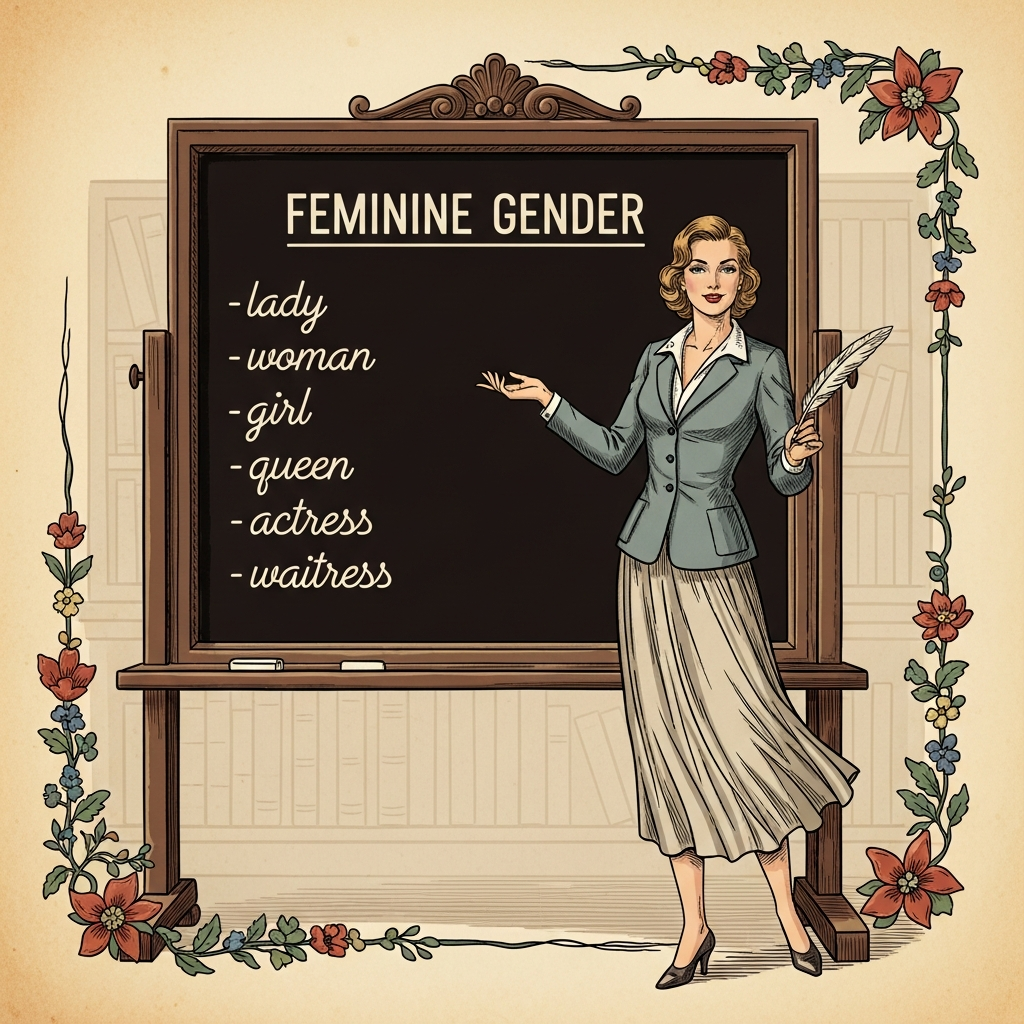
Definition, Rules, Examples, Pronouns, and Practice
Nouns and pronouns in the English language are classified into three genders: masculine, feminine, and neuter. Among these, the feminine gender plays an important role in identifying words that refer to female people, animals, and sometimes roles or titles. One common and important example of the feminine gender is the word “lady.”
Understanding the concept of the feminine gender helps students improve their English grammar, perform better in school exams, and speak and write more confidently. Many exam questions focus on identifying feminine gender nouns or converting masculine nouns into their feminine forms. Therefore, learning the rules and examples of the feminine gender is essential for every English learner.
What Is Feminine Gender?
The feminine gender refers to nouns and pronouns that represent female counterparts of people, animals, or birds. According to standard English grammar definitions, feminine gender words are used for females and often have a special form that distinguishes them from masculine nouns.
For example:
- Man → Woman
- King → Queen
- Fox → Vixen
- Gentleman → Lady
The word lady is a clear example of a feminine gender noun, commonly used to describe a woman politely or respectfully.
Read More Articles: SHIP Suffix Words
Lady as a Feminine Gender Noun
The word lady belongs to the feminine gender because it refers specifically to a female person. In English grammar, “lady” is often used as the feminine form of “gentleman,” although both words can also stand independently depending on context.
Examples:
- She is a kind lady.
- The lady welcomed the guests warmly.
- Every lady deserves respect.
In all these sentences, the word lady clearly represents a female person, making it an important example when studying feminine gender nouns in English grammar.
Feminine Gender Definition (Exam-Friendly)
The feminine gender is used to name female persons, animals, or birds.
It answers questions like:
- What is the feminine gender of a gentleman? → Lady
- What is the feminine gender of fox? → Vixen
This definition is frequently asked in school exams and grammar tests, so students should remember it clearly.
Feminine Gender Pronouns
Pronouns also play a major role in identifying the feminine gender.
Common Feminine Pronouns:
- She
- Her
- Hers
- Herself
Example:
The lady lost her bag, but she found it herself. The bag was hers.
These pronouns replace feminine nouns and help avoid repetition in sentences.
Examples of Feminine Gender (People)
Below is a list of commonly used feminine gender words related to people and occupations:
- Lady
- Woman
- Girl
- Mother
- Daughter
- Sister
- Aunt
- Wife
- Queen
- Princess
- Duchess
- Countess
- Empress
- Actress
- Heroine
- Waitress
- Hostess
- Governess
- Nurse
- Maid
- Nun
- Priestess
These words are widely used in daily conversation, textbooks, and examinations.
Feminine Gender of Animals
Many animals have special feminine names that are different from their masculine forms. Learning these is important for grammar accuracy.
Read More Articles: Collective Noun
Examples of Feminine Gender of Animals:
- Fox → Vixen
- Lion → Lioness
- Tiger → Tigress
- Cow → Cow (female of bull)
- Horse → Mare
- Deer → Doe
- Sheep → Ewe
- Peacock → Peahen
- Drake → Duck
- Gander → Goose
- Dog → Bitch
Such examples are often included in the feminine gender.
Rules for Identifying Feminine Gender Nouns
Understanding the rules of the feminine gender makes learning easier and systematic.
1. Using the Suffix “-ess.”
Many feminine nouns are formed by adding ess to masculine nouns.
- Actor → Actress
- Host → Hostess
- Prince → Princess
- Duke → Duchess
2. Special Feminine Words
Some words change completely and do not follow a pattern.
- Fox → Vixen
- Bull → Cow
- Ram → Ewe
3. Different Pronouns
Feminine gender nouns usually use feminine pronouns.
- Lady → She / Her
4. Using “Female” Before Nouns
In some cases, gender is shown by adding the word female.
- Female teacher
- Female doctor
Feminine Form of Nouns (Masculine vs Feminine)
Understanding the difference between masculine and feminine genders helps in sentence formation and grammar correction.
| Masculine | Feminine |
| Man | Woman |
| Gentleman | Lady |
| King | Queen |
| Prince | Princess |
| Actor | Actress |
| Hero | Heroine |
| Emperor | Empress |
Such tables are extremely useful for school exam grammar preparation.
Importance of Learning Feminine Gender
Learning feminine nouns in English grammar improves:
- Grammar accuracy
- Vocabulary skills
- Sentence construction
- Speaking and writing skills
It also helps students answer questions like:
- Identify the feminine gender.
- Write the feminine form of the given noun.
- Use feminine pronouns correctly.
Feminine Gender in Daily Language
Words like lady, woman, and girl are commonly used in everyday communication. Using correct gender forms shows good language skills and respect in conversation.
Example:
- Instead of saying “that person,” saying “that lady” is clearer and more polite.
Practice Examples (Quick)
Change the masculine gender to the feminine gender:
- Gentleman → Lady
- King → Queen
- Fox → Vixen
- Actor → Actress
- He → She
Conclusion
The concept of the feminine gender is an important part of English grammar. By understanding definitions, rules, pronouns, and examples of the feminine gender, learners can greatly improve their language skills. Words like lady not only represent the feminine gender but also add clarity and respect to communication.
Mastering feminine gender nouns and pronouns makes English easier, more accurate, and more enjoyable to learn.
FAQ’S
q1.What is the feminine gender?
Feminine gender refers to words that name female persons, animals, or birds.
q2. Is “lady” a feminine gender noun?
Yes, lady is a feminine gender noun used for a female person.
q3. What are feminine pronouns?
She, her, hers, and herself are feminine pronouns.
q4. Why is the feminine gender important?
It helps in correct grammar usage, exams, and effective communication.

AI-powered SEO content writer with 3 years of experience in creating clear, helpful, and search-engine-optimized content using AI and human research.